Welcome back!
Ready to check out?
You're just one click away from fantastic style and even better savings!
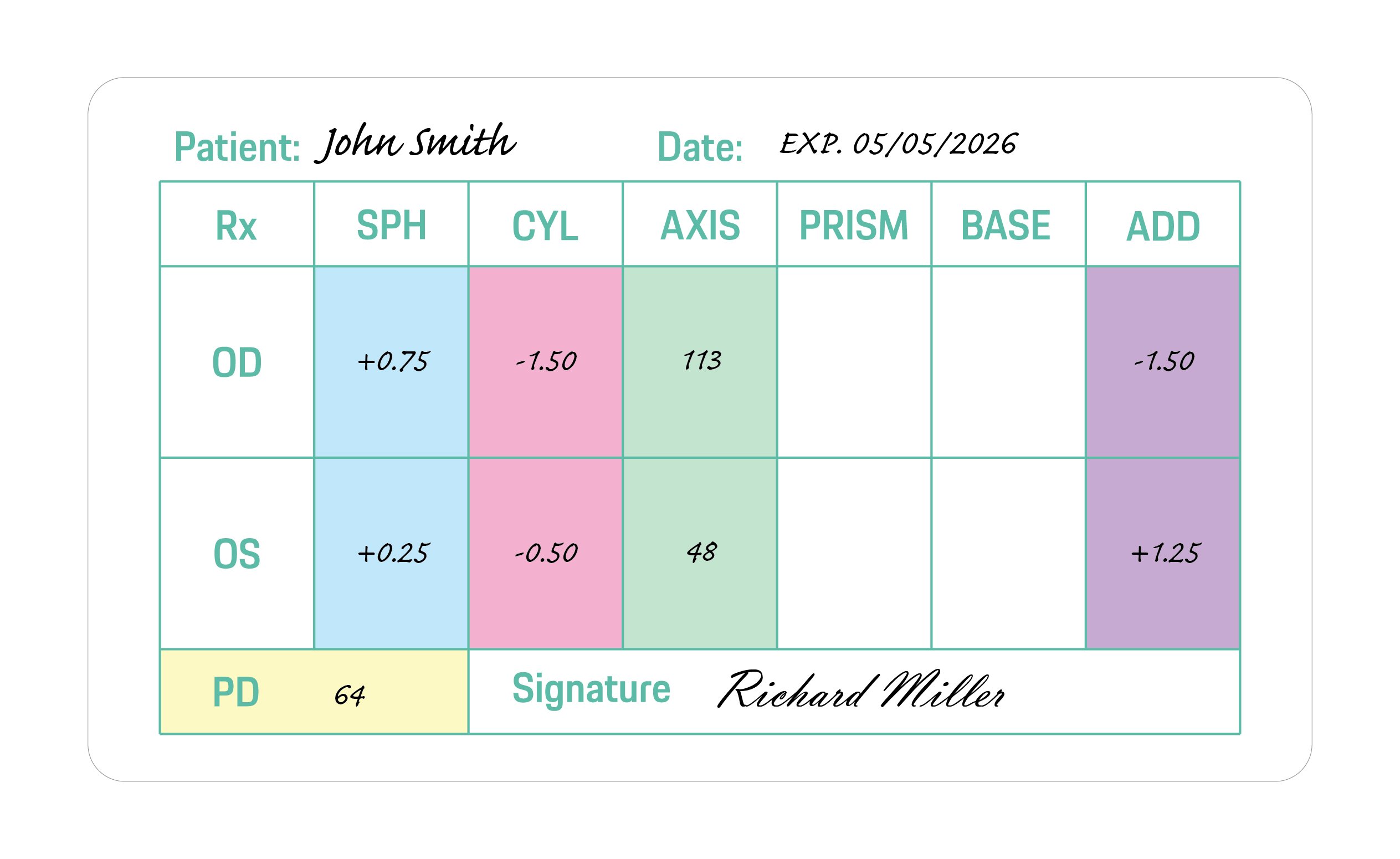
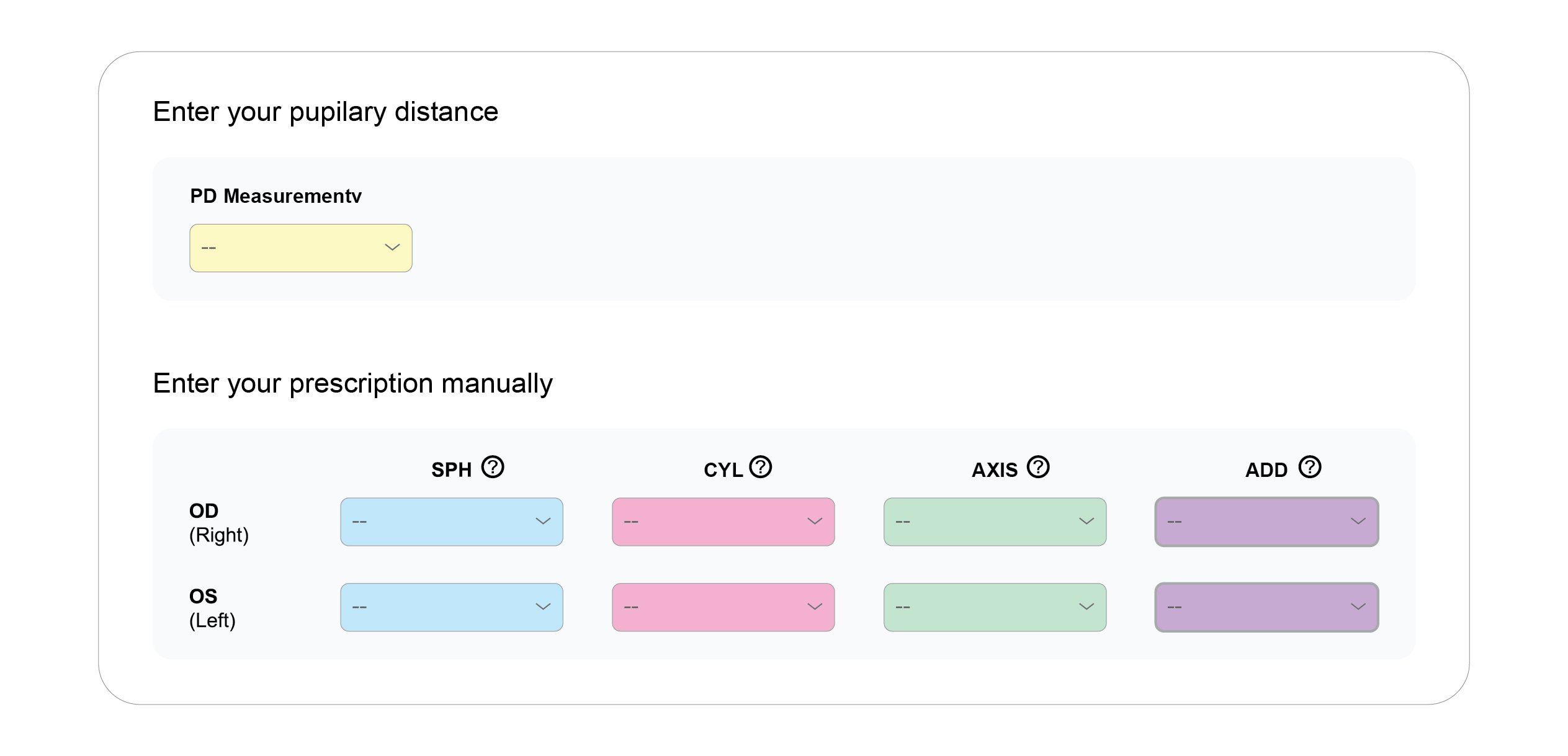
OD is an abbreviation for the Latin term oculus dexter which means right eye. Notice that the right eye information is asked for first even though we typically read from left to right.
OS is an abbreviation of the Latin oculus sinister which means left eye. That will be referenced on the far right column of the prescription.
SPH is short for sphere. The sphere of your prescription indicates the power on the lenses that is needed to see clearly. A plus (+) symbol indicates the eyeglass wearer is farsighted. A minus (-) symbol indicates that the eyeglass wearer is nearsighted.
CYL is short for cylinder. The cylinder indicates the lens power necessary to correct astigmatism. If the column has no value (is blank), it indicates that the eyeglass wearer does not have astigmatism. If this is the case on your prescription, you can leave it blank when entering it in.
AXIS is a prescription will include an axis value for those with astigmatism. This number represents the angle of the lens that shouldn't feature a cylinder power to help correct your astigmatism.
ADD is short for "additional correction." This is where details about bifocals, multifocal lenses or progressive lenses would appear.
But what drives the global fascination with characters who are neither fully human nor entirely beast? The answer lies in a potent mix of psychological shorthand, cultural folklore, and a surprising degree of narrative versatility. At its core, the Animal Girl acts as a visual cheat sheet for personality. A fox tail signals cunning or mischief; rabbit ears denote timidity or heightened hearing; feline features suggest aloof independence. This “visual coding” allows creators to bypass lengthy exposition. In the 2022 indie hit Signalis , the protagonist’s cyborg-hermit crab design isn’t just aesthetic—it’s a clue to her memory-hoarding nature. In Beastars , the wolf girl Juno uses her predatory features to explore high school social predation.
By [Feature Writer Name]
In the vast menagerie of popular media, few character designs are as instantly recognizable—or as deceptively complex—as the “Animal Girl.” She might be a high school student with cat ears peeking through her hair, a wolf-eared mercenary in a gritty video game, or a bunny-eared detective in a neo-noir animated film. Known in anime circles as Kemonomimi (literally “animal ears”), this archetype has migrated from niche otaku culture to a mainstream staple, appearing everywhere from Disney blockbusters to mobile game ads. animal girl xxx
As climate anxiety and digital isolation grow, perhaps the Animal Girl’s greatest power is nostalgia for a wildness we’ve lost—a pair of wolf ears reminding us that even in a filtered, urbanized world, instinct still has a voice. And she’s probably selling you bubble tea. But what drives the global fascination with characters
However, defenders point to a growing subversion. BNA: Brand New Animal ’s Michiru Kagemori doesn’t just flaunt her tanuki features; she weaponizes her shapeshifting to fight systemic racism against beastmen. The indie game Night in the Woods uses its all-animal cast to explore economic depression and mental illness—subjects that feel less threatening filtered through a cartoon cat. The Animal Girl has now leaped off the screen. In Tokyo’s Akihabara, “neko cafe” waitstaff wear custom silicone ears that move via facial recognition. On TikTok, the “#therian” community (people who identify spiritually as animals) uses Animal Girl aesthetics as a visual language for identity. And with the rise of VR avatars and AI companions, the line between watching an Animal Girl and being one is blurring. A fox tail signals cunning or mischief; rabbit
*Discount applied on the current website price at the time of order. Offer only valid for new customer first contacts order over $10. Maximum discount of $100. Cannot be combined with any other offers. Promotions are subject to change without notice. We reserve the right to cancel orders that are in breach of the terms and conditions of this offer.



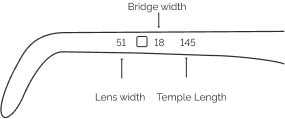
| Lens Width | Bridge Width | Temple Length | |
|---|---|---|---|
| XS | < 42 mm | < 16 mm | <=128 mm |
| S | 42 mm - 48 mm | 16 mm - 17 mm | 128 mm - 134 mm |
| M | 49 mm - 52 mm | 18 mm - 19 mm | 135 mm - 141 mm |
| L | >52 mm | >19 mm | >= 141 mm |
Buying eyewear should leave you happy and good-looking. Use our sizing tool to find frames that best fit your unique facial measurements.
Grab a regular card with a magnetic stripe on the back. Student IDs, credit cards and gift cards work well to start our online PD tool.
You may have received our paper PD measurement tool in your recent online order. In order to use this tool, place the ruler on your eyes so that the "0" lines up at the centre in between your eyes. Add up the two numbers, to get your PD. See example below:
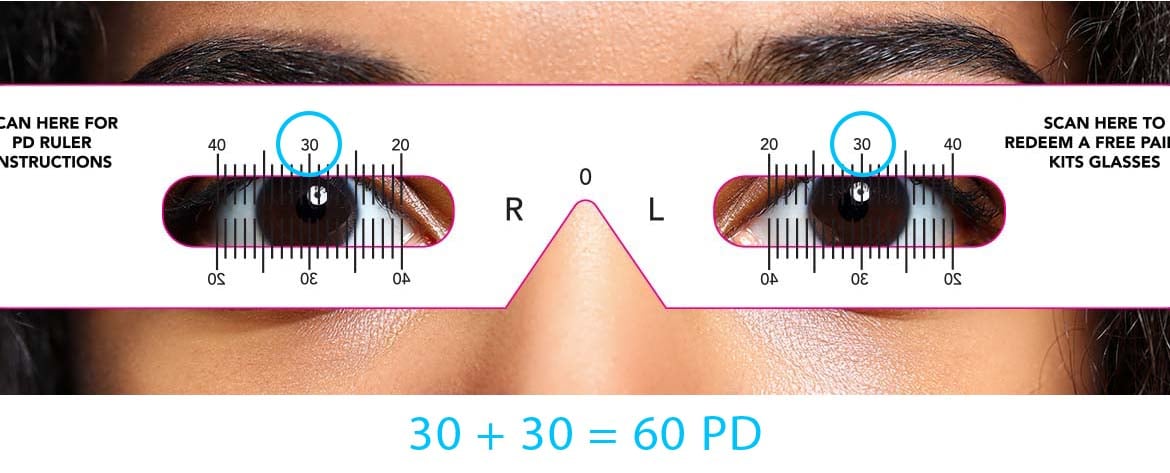
Click on this link to download and print your own PD measurement tool.
DOWNLOAD



 Check order status
 Place reorder
 Chat with us





 Use your insurance
 Help
Help