|
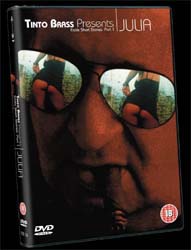
In this collection of three stories, an emotionally abused
wife finds comfort in the arms of her brother-in-law, a young
dancer undertakes an erotic and redemptive pilgrimage to Rome
involving live sex shows and nude photography, and a femme
fatale looks into a mirror as she recalls a sadomasochistic
love affair...
Try
imagining an erotic version of Alfred Hitchcock Presents,
and you'll have some idea of what this DVD series is like.
Only less well made. Producer Tinto Brass has little direct
involvement with these short films, apart from introducing
each one while puffing away characteristically on a cigar,
and making the occasional cameo appearance.
Though
the productions claim to have been directed in the "Tinto
Brass style", there is scant evidence of it here. Only in
A Magic Mirror is there any hint of Brass's eccentricity,
in the grotesque character of a brusque layabout husband (Ronaldo
Ravello), who spends much of his screen time lounging around
in a bath, like the captain of the B-Ark in The Hitchhiker's
Guide to the Galaxy. But, although this tale displays
the most humour in the entire collection, it also shows off
the least amount of bare flesh, which is surely another important
ingredient that the audience will be expecting.
Things
get sexier in Julia, the story from which this collection
takes its name, which includes some particularly explicit
and highly charged sex scenes. Unfortunately, the plot is
almost totally incomprehensible - something to do with a dancer
(Anna Biella) going to Rome, but wildly at odds with the description
on the back of the sleeve, which mentions a photographer's
three beautiful models. I counted two of them at the most.
This production is also blighted by amateurish editing, which
leaves several gaping holes in the soundtrack. Oh well, at
least this DVD is subtitled, which spares us from woeful English
dubbing of the type recently heard on Brass's Private.
The
final tale, I Am the Way You Want Me, is a very weird
and nasty little minx. In it, a naked woman (Fiorella Rubino)
sprawls around in her bathroom, mouthing various strange utterances
to camera, and doing erotic things to herself, such as shaving
with a fearsome-looking cutthroat razor (shudder). And that's
about it.
A
further disappointment is the lack of any extra features.
So, all in all, this DVD has left me feeling rather brassed
off!
Chris
Clarkson

Yandere Simulator Gore May 2026
This deliberate clash is the game’s signature. The contrast between the pastel hallways and the pooling crimson is jarring. It forces the player to confront an uncomfortable question: Why is this fun? The gore isn’t there for shock value alone; it’s a mechanical reward. It’s the visual payoff for successfully stalking a rival, learning her schedule, and leading her to a secluded spot behind the school gym.
In the sprawling, often chaotic ecosystem of indie game development, few titles have sparked as much controversy, fascination, and morbid curiosity as Yandere Simulator . At its core, the game is a stealth-action sandbox about a high school girl, Ayano Aishi, whose obsessive love for a boy named Senpai drives her to eliminate any romantic rival—by any means necessary. While the game’s aesthetic is deliberately cute, with anime-style character models and a bubbly J-pop soundtrack, it is inextricably linked to a darker undercurrent: its gore.
Ultimately, "Yandere Simulator gore" is a fascinating cultural artifact. It represents the modern gaming id: the desire to see consequences in a consequence-free space. The pixelated blood on the school tiles isn’t real, but the feeling it evokes—the quickening pulse, the guilty grin, the slight recoil—is genuine. yandere simulator gore
Of course, any discussion of this content must acknowledge the elephant in the room. Yandere Simulator has been mired in controversy, not just for its content but for its developer’s behavior. The game’s gore is often cited by critics as gratuitous, a crutch used to generate shock value and YouTuber reactions without the narrative maturity to handle the subject matter. Unlike Doki Doki Literature Club! , which uses gore to deconstruct mental illness and player complicity, Yandere Simulator often feels like a gore sandbox first and a story second.
It asks the player: How far would you go for love? And then, with a cheerful jingle and a splash of red, it hands you the mop and says, Now clean up the mess before the student council arrives. In that dissonance lies the strange, uncomfortable, and undeniably compelling heart of the game. This deliberate clash is the game’s signature
This is where the line blurs. For some, the gore is a serious exploration of the yandere archetype (a character who is sweet and loving until jealousy triggers a murderous rage). For others, it’s a dark comedy sandbox, no different from Happy Tree Friends or South Park .
The phrase "Yandere Simulator gore" also points to the fan community. Because the game’s development has been notoriously slow, fans have filled the void with their own creations. A search for the term reveals a sprawling subculture of fan art, animation memes, and "kill compilations" on YouTube. Here, the violence is amplified, exaggerated into hyper-gore—eyes popping out, blood geysering like a fountain, organs spilling out in comical loops. The gore isn’t there for shock value alone;
The phrase "Yandere Simulator gore" isn't just a tag on a fan wiki; it’s a promise and a warning. It represents the game’s central, uncomfortable thesis: that violence, when dressed in a sailor uniform and executed with a giggle, can be both horrifying and absurdly mundane. |
|
|
£15.99
(Amazon.co.uk) |
| |
|
|
|
£15.49
(MVC.co.uk) |
| |
|
|
|
£15.49
(Streetsonline.co.uk) |
All prices correct at time of going to press.
|
|