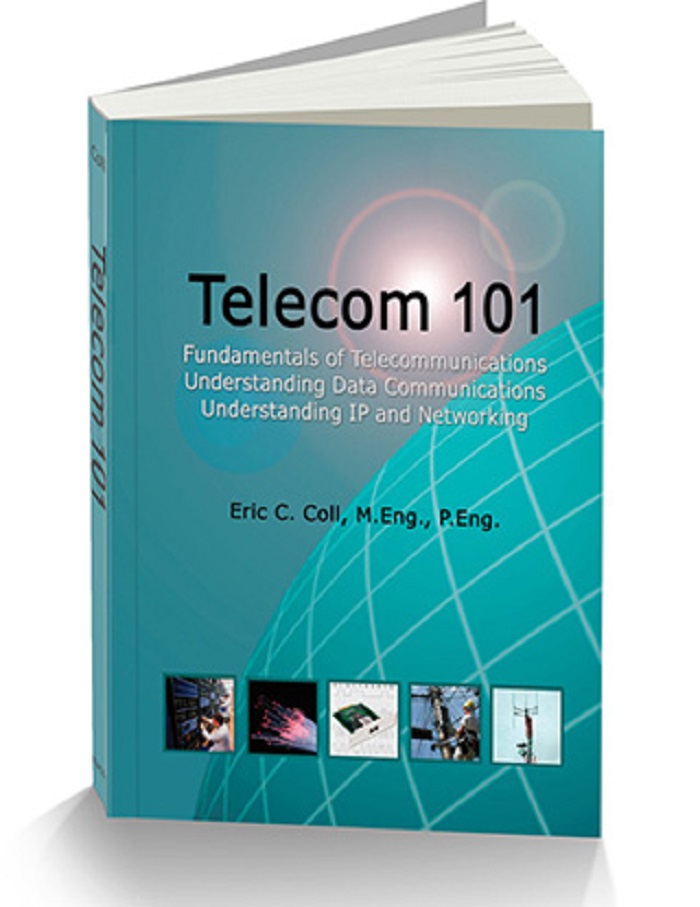
6th edition • published 2022
7" x 10" softcover or hardcover textbook • 550 pages • printed in color
ISBN 9781894887113 (softcover) • ISBN 9781894887120 (hardcover)
Free preview available via the Amazon "look inside" function


eBook (ISBN 9781894887137) available from:



All Major Telecommunications Topics covered ... in Plain English. Packed with up-to-date information and covering all major topics. Telecom 101 is an authoritative day-to-day reference and an invaluable textbook on telecom.
Updated and revised throughout, Telecom 101: Sixth Edition includes the materials from the most recent version of Teracom's popular Course 101 Broadband, Telecom, Datacom and Networking for Non-Engineers, and more topics.
Telecom 101 serves as the study guide for the TCO, Telecommunications Certification Organization, Certified Telecommunications Analyst (CTA) certification, including all required material for the CTA Certification Exam, except the security module.
Telecom 101 brings you completeness, consistency and unbeatable value in one volume.
Our philosophy is simple: Start at the beginning. Proceed in a logical order. Build concepts one on top of another. Speak in plain English. Avoid jargon.
Knowledge and understanding to last a lifetime... Build a solid base of structured knowledge and fill in the gaps. Cut through the doubletalk, demystify the jargon, bust the buzzwords. Understand how everything fits together!
The ideal book for anyone needing an understanding of the major topics in telecom, IP, data communications, and networking. Clear, concise, organized knowledge ... available in one place!
We talk a lot about the devices that changed the world: the iPhone, the Kindle, the iPod. But what about the devices that tried to bridge the gap? The ones that weren't quite famous, but for a specific moment in time, felt like magic?
But oh, the battery life. You could fly from New York to Tokyo, watch three movies, listen to an album, and still have 40% left. Modern phones die if you look at them wrong. The branding was aspirational. In 2010, we believed digital content would last forever. You would "rip" your DVD collection, store it on your hard drive, and carry your library in your pocket for eternity.
HDTC likely stood for or High Capacity . The device was a rectangular brick—thicker than any modern phone—with a glossy screen and a minimalist set of physical buttons (volume, power, and a mysterious "M" button that nobody ever used). eternity hdtc
It won't replace your iPhone. But it might remind you of a time when "HD" was a luxury, "touch" was a novelty, and a battery that lasted a whole day felt like eternity.
I recently found an old gadget in a drawer at my parents’ house. The screen protector was peeling, the fake leather case was sticky, and the battery was as flat as a pancake. The device was labeled simply: . We talk a lot about the devices that
And in 2024, that’s kind of beautiful.
For those of you who came of age in the post-iPhone 4 world, this name might mean nothing. But for those who lived through the wild west of portable media (circa 2009–2012), seeing that name sparked a flood of memories. In the simplest terms, the Eternity HDTC was a "PMP" (Portable Media Player). But calling it that is like calling a Swiss Army knife a "metal stick." But oh, the battery life
We were half right. The content lasted. But the device? The Eternity HDTC had one fatal flaw: the proprietary charging cable. It was a 30-pin connector that looked like a USB but wasn't. Once you lost that cable, your "Eternity" became a paperweight. Finding this old Eternity HDTC felt like finding a time capsule. It didn't have WiFi. It didn't have Bluetooth. It couldn't take a photo. All it could do was play video, play music, and display text files.
We talk a lot about the devices that changed the world: the iPhone, the Kindle, the iPod. But what about the devices that tried to bridge the gap? The ones that weren't quite famous, but for a specific moment in time, felt like magic?
But oh, the battery life. You could fly from New York to Tokyo, watch three movies, listen to an album, and still have 40% left. Modern phones die if you look at them wrong. The branding was aspirational. In 2010, we believed digital content would last forever. You would "rip" your DVD collection, store it on your hard drive, and carry your library in your pocket for eternity.
HDTC likely stood for or High Capacity . The device was a rectangular brick—thicker than any modern phone—with a glossy screen and a minimalist set of physical buttons (volume, power, and a mysterious "M" button that nobody ever used).
It won't replace your iPhone. But it might remind you of a time when "HD" was a luxury, "touch" was a novelty, and a battery that lasted a whole day felt like eternity.
I recently found an old gadget in a drawer at my parents’ house. The screen protector was peeling, the fake leather case was sticky, and the battery was as flat as a pancake. The device was labeled simply: .
And in 2024, that’s kind of beautiful.
For those of you who came of age in the post-iPhone 4 world, this name might mean nothing. But for those who lived through the wild west of portable media (circa 2009–2012), seeing that name sparked a flood of memories. In the simplest terms, the Eternity HDTC was a "PMP" (Portable Media Player). But calling it that is like calling a Swiss Army knife a "metal stick."
We were half right. The content lasted. But the device? The Eternity HDTC had one fatal flaw: the proprietary charging cable. It was a 30-pin connector that looked like a USB but wasn't. Once you lost that cable, your "Eternity" became a paperweight. Finding this old Eternity HDTC felt like finding a time capsule. It didn't have WiFi. It didn't have Bluetooth. It couldn't take a photo. All it could do was play video, play music, and display text files.
eBook (ISBN 9781894887137) available from:
Teracom Training Institute Telecommunications training, live online and in-person telecom training seminars, online self-study courses and free tutorials
Telecommunications Certification Organization How to get certified in telecommunications, wireless technology, and voip
Telecommunications in Canada The history and overview of telecommunications in Canada