Biblia Ortodoxa En Español May 2026
We make travel easy for Travelers, Students, Digital Nomads and Travel Agents
We have helped more than 1 000 000 travellers and 200+ Travel and Visa agents
Flight Reservation
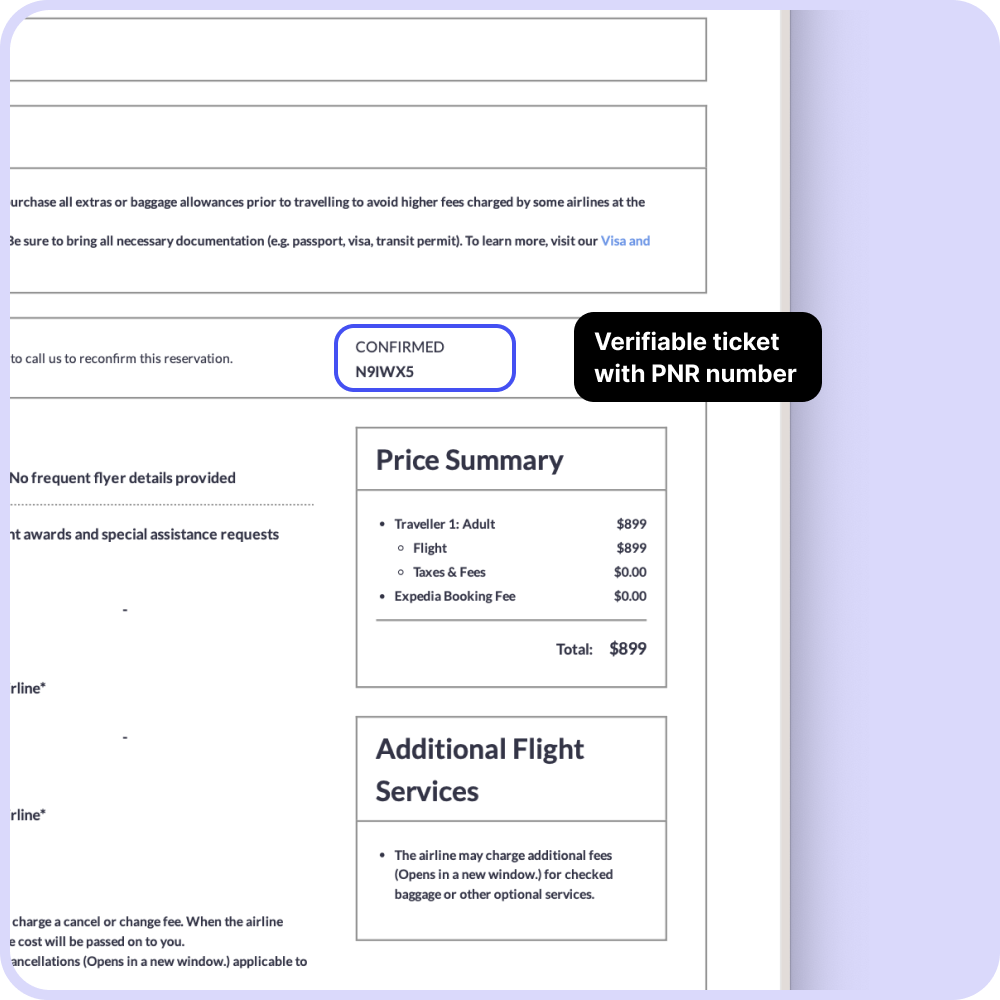
Flight bookings with a verifiable PNR number can help travelers obtain a visa and enter a country. The PNR is a unique identifier that can verify a ticket has been booked and show proof of plans to leave the country. This can help make entry into a country stress-free.
Reservation can be checked on the airline's website or GDS, such as checkmytrip.com or viewtrip.travelport.com
- Verifiable ticket with PNR number
- Reservation code will be valid for a maximum of 14 days
- One ticket may include up to 4 passengers
- You will receive your ticket within 24 hours
Get Flight Reservation
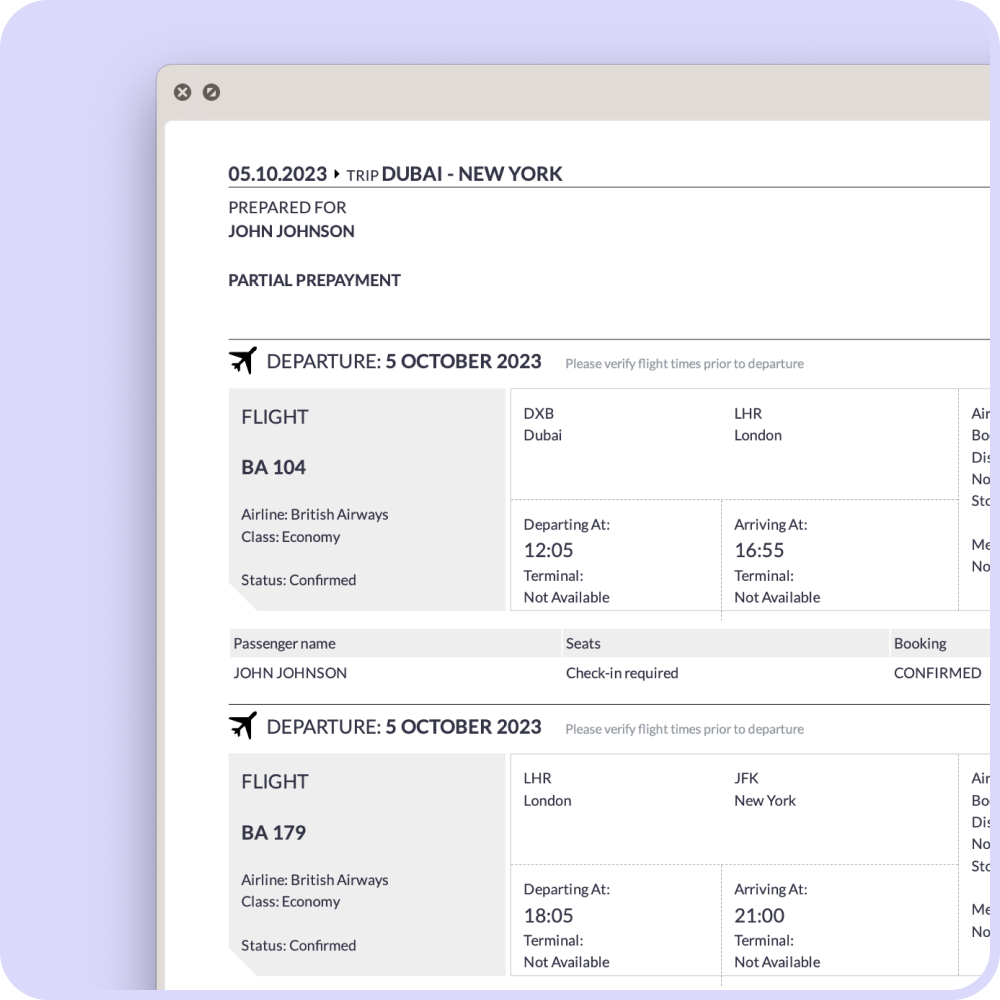
Sample ticket
A sample/onward/dummy ticket is a ticket for a future flight. It looks like a real ticket, but it does not have a PNR code, meaning it is not verifiable.
- Instant flight ticket creation
- With a flight price on a ticket
- Non verifiable ticket
Try for Free
Examples of usage
Travel Visa
Onward Ticket
Business Trip Confirmation
Travel Agency
Travel Visa
In many cases, a flight reservation is an important aspect of the visa application process, as it can provide evidence that you have concrete plans to travel. By having a flight reservation, the issuing authority can better assess the applicant's intent to travel, as well as their ability to pay for the flight and other related expenses. Ultimately, a flight reservation can be a useful tool for visa applicants, as it can help demonstrate their commitment to traveling and complying with visa regulations.
Onward Ticket
It's a common requirement, and many countries require travelers to present a flight reservation or ticket for their onward journey when they arrive. This helps to demonstrate that the traveler has the financial means to pay for the journey and that they have a definite plan for their stay. It can also help authorities feel more secure in the knowledge that the traveler will not overstay their allotted time in the destination country.
Business Trip Confirmation
It's a common requirement that many organizations have when booking a business trip, as they want to make sure that you are actually scheduled to fly and that you will be present for the duration of the trip. Having a flight reservation is a way of providing this confirmation and is often used in the process of obtaining a visa or other travel documents. It's important to keep in mind that having a flight reservation does not guarantee you a seat on the flight, and you may still need to purchase a ticket to board the plane.
Travel Agency
Our team of experts will work with you to ensure that your clients' flight reservations are confirmed and guaranteed, giving you the peace of mind that comes with a successful visa application. Our fast and efficient service means that you can quickly and easily secure the flight reservations you need, without any hassle. Special prices coming soon.
Biblia Ortodoxa En Español May 2026
Thus, a Spanish Orthodox Bible cannot merely reprint a Catholic Biblia de Jerusalén or a Protestant Reina-Valera . It requires a specific translation that respects the Septuagint as the primary Old Testament source, rather than the Hebrew Masoretic Text. For example, the famous prophecy of the virgin birth in Isaiah 7:14 uses the Greek word parthenos (virgin), whereas the Hebrew almah (young woman) has led to divergent translations. An Orthodox Spanish Bible must follow the Septuagint reading to align with patristic theology. The Orthodox Church does not primarily read the Bible in private study; it chants it liturgically. The Evangelion (Gospel book) and Apostolos (Epistle and Acts book) are processed and read aloud during the Divine Liturgy. Consequently, a Biblia Ortodoxa en español must be translationally suitable for oral, rhythmic proclamation. This is a unique requirement that standard Spanish translations, often optimized for silent reading or theological precision, do not meet.
In conclusion, the Biblia Ortodoxa en español is not merely a translation project; it is an act of ecclesial unity and patristic recovery. It must be more than accurate—it must be liturgically singable, theologically Orthodox, and culturally accessible to a world shaped by centuries of Catholic and Protestant biblical traditions. Until that day arrives, the Spanish-speaking Orthodox faithful will continue to piece together their Scriptures, praying and chanting in two languages at once: the Greek of the Fathers and the Spanish of their hearts, awaiting a Bible that is finally, fully their own. biblia ortodoxa en español
For centuries, the Spanish language has been inextricably linked to Roman Catholicism. From the Biblia Alfonsina in the Middle Ages to the ubiquitous Reina-Valera of the Reformation, the Bible in Spanish has typically carried a distinct confessional identity. However, the growing presence of Orthodox Christianity in the Spanish-speaking world—from Spain and Mexico to Argentina and Colombia—has given rise to a pressing and complex need: the development of a Biblia Ortodoxa en español . Unlike the static canons of the West, the Orthodox Bible is not a single book but a living, liturgical canon rooted in the Septuagint (the Greek Old Testament) and the Byzantine text of the New Testament. Its translation into Spanish represents a profound theological, philological, and cultural challenge. The Canonical Difference: More Than Just Books The most immediate distinction of an Orthodox Bible lies in its Old Testament canon. While Catholic Bibles include the Deuterocanonical books (Tobit, Judith, Wisdom, Sirach, Baruch, and Maccabees) and Protestant Bibles exclude them entirely, the Orthodox canon is more expansive and fluid. The Biblia Ortodoxa traditionally includes all the Catholic deuterocanonical books plus additional texts: 1 Esdras (also called 3 Esdras), 3 Maccabees , 4 Maccabees (often in an appendix), Psalm 151 , and the Prayer of Manasseh . Furthermore, Orthodox tradition considers 1 Enoch and the Book of Jubilees as historically and theologically significant, even if not fully canonized in the same way. Thus, a Spanish Orthodox Bible cannot merely reprint
What our customers say
MESSAGES
Andrea Botez
I made a reservation for $21,90. There were no problems with this ticket at the border control.
MESSAGES
Anna Darovski
Very fast in delivering services ⚡
MESSAGES
Marijana
Hi, I bought a ticket on this site 2 days ago. The guys helped to make a difficult reservation, although they warned that the reservation could only work for a couple of days.
MESSAGES
Artem Svirchevskiy
Everything went amazing! I wasn't too nervous when an airline employee checked the return ticket by checking my booking number. I was flying to Thailand before Christmas and didn't want to get stuck at such a crazy time when tickets cost overprices. Booked on a key flight for just $21,90, and it's worth it. Thanks to the service and its creators.
Thus, a Spanish Orthodox Bible cannot merely reprint a Catholic Biblia de Jerusalén or a Protestant Reina-Valera . It requires a specific translation that respects the Septuagint as the primary Old Testament source, rather than the Hebrew Masoretic Text. For example, the famous prophecy of the virgin birth in Isaiah 7:14 uses the Greek word parthenos (virgin), whereas the Hebrew almah (young woman) has led to divergent translations. An Orthodox Spanish Bible must follow the Septuagint reading to align with patristic theology. The Orthodox Church does not primarily read the Bible in private study; it chants it liturgically. The Evangelion (Gospel book) and Apostolos (Epistle and Acts book) are processed and read aloud during the Divine Liturgy. Consequently, a Biblia Ortodoxa en español must be translationally suitable for oral, rhythmic proclamation. This is a unique requirement that standard Spanish translations, often optimized for silent reading or theological precision, do not meet.
In conclusion, the Biblia Ortodoxa en español is not merely a translation project; it is an act of ecclesial unity and patristic recovery. It must be more than accurate—it must be liturgically singable, theologically Orthodox, and culturally accessible to a world shaped by centuries of Catholic and Protestant biblical traditions. Until that day arrives, the Spanish-speaking Orthodox faithful will continue to piece together their Scriptures, praying and chanting in two languages at once: the Greek of the Fathers and the Spanish of their hearts, awaiting a Bible that is finally, fully their own.
For centuries, the Spanish language has been inextricably linked to Roman Catholicism. From the Biblia Alfonsina in the Middle Ages to the ubiquitous Reina-Valera of the Reformation, the Bible in Spanish has typically carried a distinct confessional identity. However, the growing presence of Orthodox Christianity in the Spanish-speaking world—from Spain and Mexico to Argentina and Colombia—has given rise to a pressing and complex need: the development of a Biblia Ortodoxa en español . Unlike the static canons of the West, the Orthodox Bible is not a single book but a living, liturgical canon rooted in the Septuagint (the Greek Old Testament) and the Byzantine text of the New Testament. Its translation into Spanish represents a profound theological, philological, and cultural challenge. The Canonical Difference: More Than Just Books The most immediate distinction of an Orthodox Bible lies in its Old Testament canon. While Catholic Bibles include the Deuterocanonical books (Tobit, Judith, Wisdom, Sirach, Baruch, and Maccabees) and Protestant Bibles exclude them entirely, the Orthodox canon is more expansive and fluid. The Biblia Ortodoxa traditionally includes all the Catholic deuterocanonical books plus additional texts: 1 Esdras (also called 3 Esdras), 3 Maccabees , 4 Maccabees (often in an appendix), Psalm 151 , and the Prayer of Manasseh . Furthermore, Orthodox tradition considers 1 Enoch and the Book of Jubilees as historically and theologically significant, even if not fully canonized in the same way.